Introduction
One of the biggest challenges businesses face with Google Ads is generating leads that never convert into actual customers. Many advertisers celebrate getting hundreds of leads every month, only to discover that most of them are unqualified, irrelevant, or simply not ready to buy.
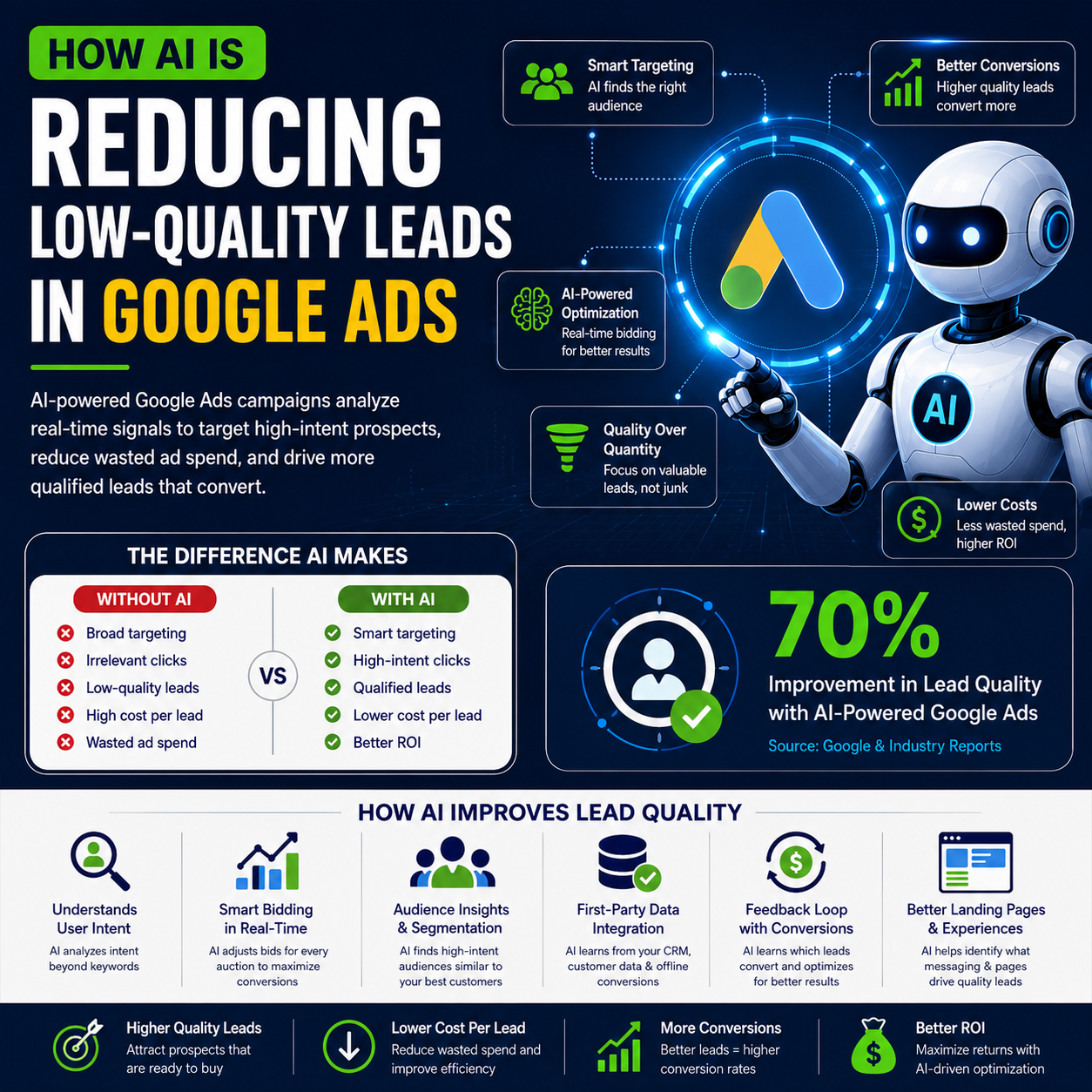
In 2026, Google Ads has evolved significantly with Artificial Intelligence (AI) becoming the driving force behind campaign optimization. Modern AI-powered Google Ads campaigns are no longer focused on generating the highest number of leads. Instead, they are designed to identify and attract users who are most likely to become paying customers.
Businesses that understand how AI works in Google Ads are seeing higher-quality leads, lower acquisition costs, and improved return on ad spend (ROAS). Google’s Smart Bidding and AI-powered optimization systems analyze hundreds of signals in real time to determine which users are more likely to convert.
The Problem with Low-Quality Leads
Before understanding how AI solves the problem, it’s important to understand why low-quality leads occur in the first place.
Common causes include:
- Broad targeting settings
- Poor keyword selection
- Weak landing pages
- Inaccurate conversion tracking
- Generic ad messaging
- Optimizing for lead quantity instead of lead quality
Many businesses unknowingly tell Google that every form submission is valuable. As a result, the platform focuses on generating more form fills rather than attracting prospects who are genuinely interested in buying.
This often leads to:
- Fake inquiries
- Spam submissions
- Job seekers filling business forms
- Students requesting information
- Competitors submitting forms
- Unqualified prospects
The result is wasted ad spend and poor sales performance.
How AI Works in Modern Google Ads
Google’s AI uses machine learning to analyze enormous amounts of user data and behavior patterns. Instead of relying solely on keywords, AI evaluates signals such as:
- User intent
- Device type
- Location
- Search history
- Time of day
- Audience behavior
- Previous website interactions
- Conversion likelihood
Google’s Smart Bidding technology adjusts bids in real time for every auction based on these signals. This helps advertisers focus their budget on users who are more likely to become valuable leads.
1. AI Prioritizes Intent Over Keywords
Traditional Google Ads campaigns focused heavily on keywords.
For example:
Keyword: “Digital Marketing Agency”
In the past, everyone searching this keyword could potentially see your ad.
Today, Google’s AI evaluates:
- Why the person is searching
- Their previous online behavior
- Their likelihood of converting
- Their engagement history
This means AI can distinguish between:
- Someone researching marketing concepts
- Someone looking for a job
- Someone actively searching for an agency
This significantly improves lead quality because ads are shown to users with stronger commercial intent. Google’s AI increasingly evaluates search intent and behavioral signals rather than keywords alone.
2. Smart Bidding Reduces Junk Leads
Smart Bidding is one of Google’s most powerful AI tools.
Popular AI bidding strategies include:
- Maximize Conversions
- Target CPA
- Maximize Conversion Value
- Target ROAS
Instead of manually setting bids, AI automatically adjusts bids for each auction based on the probability of conversion.
More importantly, modern value-based bidding allows advertisers to optimize for lead quality rather than lead quantity. Businesses can signal which leads are more valuable, helping Google prioritize those users.
Example:
A software company receives:
- Demo Request = High Value
- Ebook Download = Medium Value
- Newsletter Signup = Low Value
AI learns which users generate high-value actions and gradually shifts budget toward similar prospects.
The result:
- Fewer leads
- Higher conversion rates
- Better ROI
3. AI Uses First-Party Data to Find Better Customers
One of the biggest shifts in Google Ads is the growing importance of first-party data.
AI can analyze:
- Customer lists
- CRM data
- Purchase history
- Lead qualification data
- Offline conversions
When advertisers upload qualified customer data, Google learns what their ideal customer looks like and finds similar prospects.
This process is often powered through:
- Customer Match
- Enhanced Conversions
- Offline Conversion Tracking
- Conversion Value Rules
Advertisers who feed richer first-party data into Google generally achieve stronger lead quality because the AI learns from actual business outcomes rather than simple form submissions.
4. AI Learns Which Leads Actually Close
A major problem with traditional lead generation is that Google only sees form submissions.
It doesn’t automatically know whether:
- The lead became a customer
- The lead was qualified
- The lead generated revenue
Modern AI systems solve this through Offline Conversion Tracking.
Businesses can send qualified lead data back into Google Ads, allowing the system to learn:
- Which leads became opportunities
- Which leads became customers
- Which leads generated revenue
This feedback loop dramatically improves future lead quality because the AI optimizes toward actual business results. Industry practitioners frequently recommend feeding qualified-lead signals back into Google Ads rather than optimizing for raw form fills.
5. Performance Max Campaigns Use AI to Filter Better Prospects
Performance Max campaigns are heavily AI-driven.
They analyze signals from:
- Google Search
- YouTube
- Gmail
- Maps
- Display Network
- Discover Feed
The AI identifies patterns among high-converting users and allocates budget accordingly.
Benefits include:
- Better audience targeting
- Automated optimization
- Reduced manual management
- Improved lead quality
However, Performance Max works best when conversion tracking is accurate.
Without proper tracking, AI may optimize toward low-value actions rather than real customers.
6. AI Improves Audience Targeting
Traditional audience targeting relied on manual selections.
AI now creates dynamic audience segments based on:
- Interests
- Behaviors
- Search intent
- Website interactions
- Customer data
Google’s machine learning continuously refines these audiences based on campaign performance.
This helps businesses reach:
- High-intent prospects
- Returning visitors
- Similar audiences
- Potential buyers
Instead of targeting everyone, AI focuses on people who closely resemble your existing customers.
7. AI Detects Poor Conversion Signals
Many advertisers unknowingly train Google’s AI to chase poor-quality leads.
Examples include:
- Page visits
- Time on site
- Unqualified form submissions
- Low-value downloads
Modern AI systems perform better when conversion signals accurately reflect business value. Poor tracking and low-quality conversion inputs can cause automated systems to optimize toward the wrong outcomes.
To improve results:
- Remove unnecessary conversions
- Track qualified leads separately
- Import CRM data
- Assign conversion values
The cleaner your data, the smarter the AI becomes.
Why Businesses Still Get Low-Quality Leads Despite AI
AI is powerful, but it is not magic.
Many businesses still struggle because they have:
Poor Landing Pages
Confusing pages attract the wrong audience.
Weak Ad Copy
Generic messaging attracts unqualified clicks.
No CRM Integration
Google cannot learn which leads become customers.
Bad Conversion Tracking
AI learns from inaccurate data.
Wrong Campaign Objectives
Optimizing for form fills instead of sales quality creates poor outcomes.
As many experienced advertisers note, AI depends heavily on the quality of conversion signals and business data being provided.
How Soft Brim Media Uses AI to Improve Lead Quality
At Soft Brim Media, we combine AI-powered Google Ads strategies with advanced lead qualification techniques.
Our process includes:
- AI-driven audience targeting
- Smart Bidding optimization
- CRM integration
- Conversion Value Tracking
- Landing Page Optimization
- Enhanced Conversion Setup
- Performance Max Management
- Lead Quality Analysis
Businesses looking to improve both SEO and lead generation can also work with the team behind the Best AI SEO Expert in Delhi NCR service, where AI-powered search optimization is combined with performance marketing strategies.
Best Practices to Reduce Low-Quality Leads in Google Ads
Track Qualified Leads Instead of Form Fills
Measure actual business outcomes.
Use Offline Conversion Imports
Feed customer data back into Google Ads.
Implement Enhanced Conversions
Improve attribution accuracy.
Assign Conversion Values
Tell Google which leads matter most.
Optimize Landing Pages
Pre-qualify visitors before they submit forms.
Use AI-Powered Smart Bidding
Allow machine learning to optimize for valuable prospects.
Continuously Review Search Terms
Remove irrelevant traffic sources.
Conclusion
Artificial Intelligence is transforming Google Ads from a lead-generation platform into a customer-acquisition engine.
Rather than simply generating more leads, AI helps businesses identify, attract, and convert prospects that are most likely to become paying customers. Through Smart Bidding, audience intelligence, first-party data integration, offline conversion tracking, and value-based optimization, Google Ads is becoming significantly better at reducing low-quality leads and maximizing marketing ROI.
Businesses that embrace AI-driven advertising today will gain a major competitive advantage in 2026 and beyond, while those relying on outdated manual strategies will continue to struggle with poor lead quality and wasted ad spend.