The digital advertising landscape has undergone a tectonic shift in 2026. If 2024 and 2025 were about introducing AI, 2026 is the year it became the bedrock of the entire Google Ads ecosystem. From the “agentic” evolution of Search to the total deprecation of legacy formats, staying competitive now requires more than just keyword research—it requires a strategy built for a multimodal, AI-first world.
Here are the top updates and trends every marketer needs to master this year.
1. The Era of “AI Max” in Search
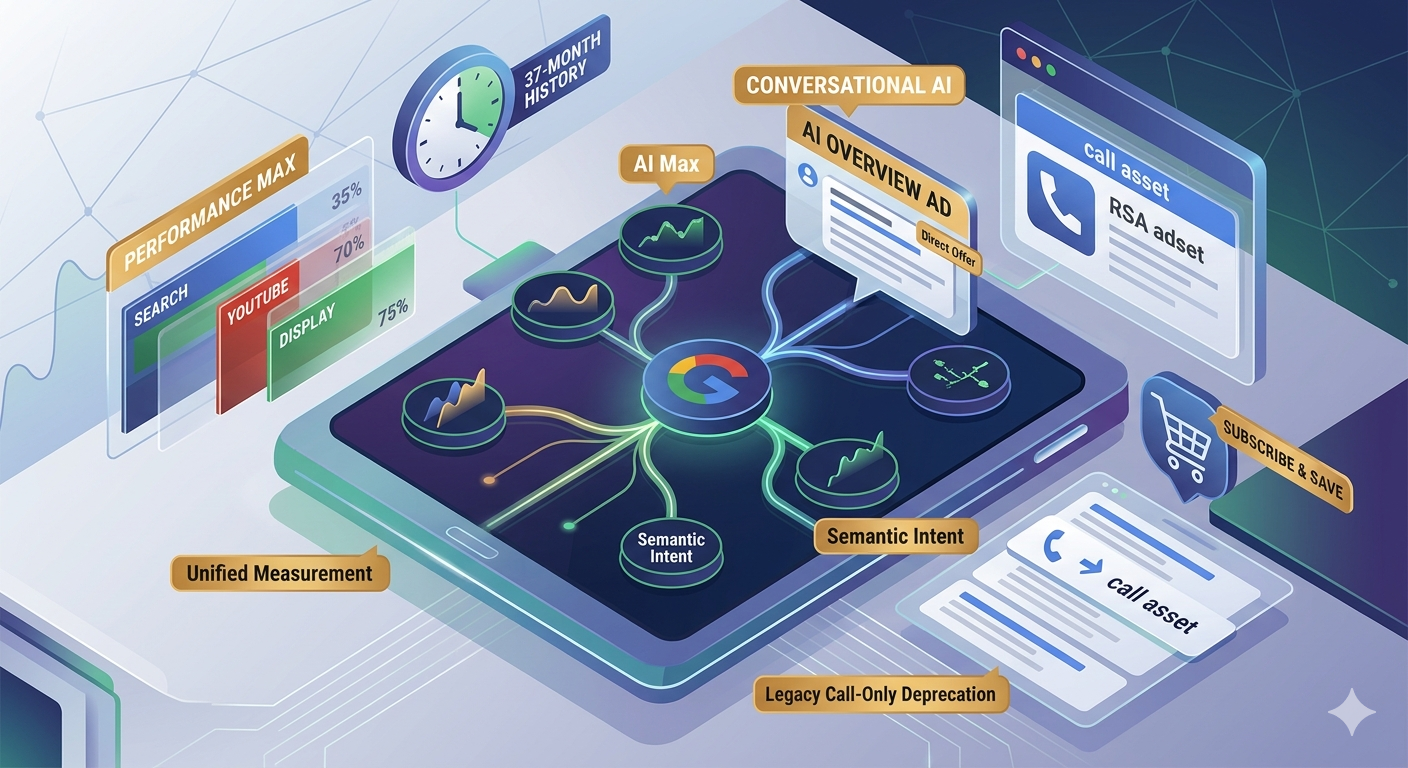
One of the most significant shifts in 2026 is the full rollout of AI Max for Search campaigns. While it sounds like a new campaign type, it is actually a comprehensive layer of AI features that transforms traditional Search.
How it works: AI Max combines broader search term matching with dynamic text customization. It uses generative AI to instantly tailor your headlines and descriptions based on a user’s specific query and real-time intent.
Final URL Expansion: Similar to Performance Max, AI Max can now dynamically select the most relevant landing page from your website to match the user’s journey.
Why it matters: Advertisers are moving away from writing fixed sets of ads. Success now depends on feeding the AI high-quality “signals” and creative assets, then letting the system assemble the perfect message in the moment.
2. Ads Integrated into AI Overviews
Google’s AI Overviews (formerly SGE) are now the standard for conversational and exploratory searches. In 2026, Google has fully integrated sponsored content into these experiences.
Contextual Placements: Ads now appear above, below, and even within AI-generated answers.
Direct Offers: A new ad format called “Direct Offers” has launched, allowing brands to share tailored loyalty benefits or product bundles directly within the AI conversational interface.
Multimodal Search: With users increasingly searching via images (Lens) and voice, ads are now being served in response to these “multimodal” inputs, requiring high-quality visual assets more than ever.
3. The Death of Call-Only Ads
As of early 2026, Call-only ads have been officially deprecated. Google is pushing all advertisers toward a more unified approach.
The Transition: Businesses that rely on phone leads must now use Responsive Search Ads (RSAs) with Call Assets.
The Logic: Google’s data shows that RSAs provide more context to the user before they click to call, leading to higher-quality leads and better conversion rates compared to the old “blind” call-only format.
4. Performance Max: Radical Transparency
After years of “black box” complaints, Google has finally opened the hood of Performance Max (PMax).
Channel-Level Reporting: Marketers can now see a clear breakdown of spend and performance across Search, YouTube, Shopping, Display, and Discover.
Asset-Level Insights: New reporting allows you to see exactly which image or video combination is driving the most value, making it easier to audit your creative strategy.
Waze Integration: PMax for store goals now includes Waze inventory, placing “Promoted Places” pins directly on a user’s navigation map.
5. Subscription Promotions in Shopping
For e-commerce and SaaS brands, the Merchant Center has introduced a game-changing feature: Subscription Promotions.
What’s New: Starting in 2026, you can highlight subscription-exclusive discounts or free trials directly within Shopping ads.
Loyalty Integration: These ads can be linked to your loyalty programs, allowing the AI to prioritize showing these offers to users who are likely to become high-value, recurring customers.
6. New 37-Month Data Retention Policy
Data privacy and system efficiency have led to a major change in how your campaign history is stored.
The Change: Starting June 1, 2026, Google Ads and its measurement APIs transitioned to a 37-month data retention policy for granular performance stats (daily, hourly, and weekly data).
Action Required: If you rely on multi-year year-over-year (YoY) analysis for long-term trends, you must now export and store your data externally using BigQuery or other third-party tools to keep records beyond the three-year mark.
Key Takeaways for 2026
Creative is the New Targeting: As AI takes over technical optimizations, your primary lever for growth is creative quality and diversity.
Focus on First-Party Data: With tracking becoming more restricted, feeding your CRM data back into Google via Enhanced Conversions is the only way to maintain bidding accuracy.
Embrace “Fluid” Experiences: Your landing pages and ad copy must be flexible enough for an AI to adapt them to a user’s conversation, not just a keyword.
The playbook has changed. Marketers who stop “managing” every keyword and start “steering” the AI with better data and creative will be the ones who win in 2026.