
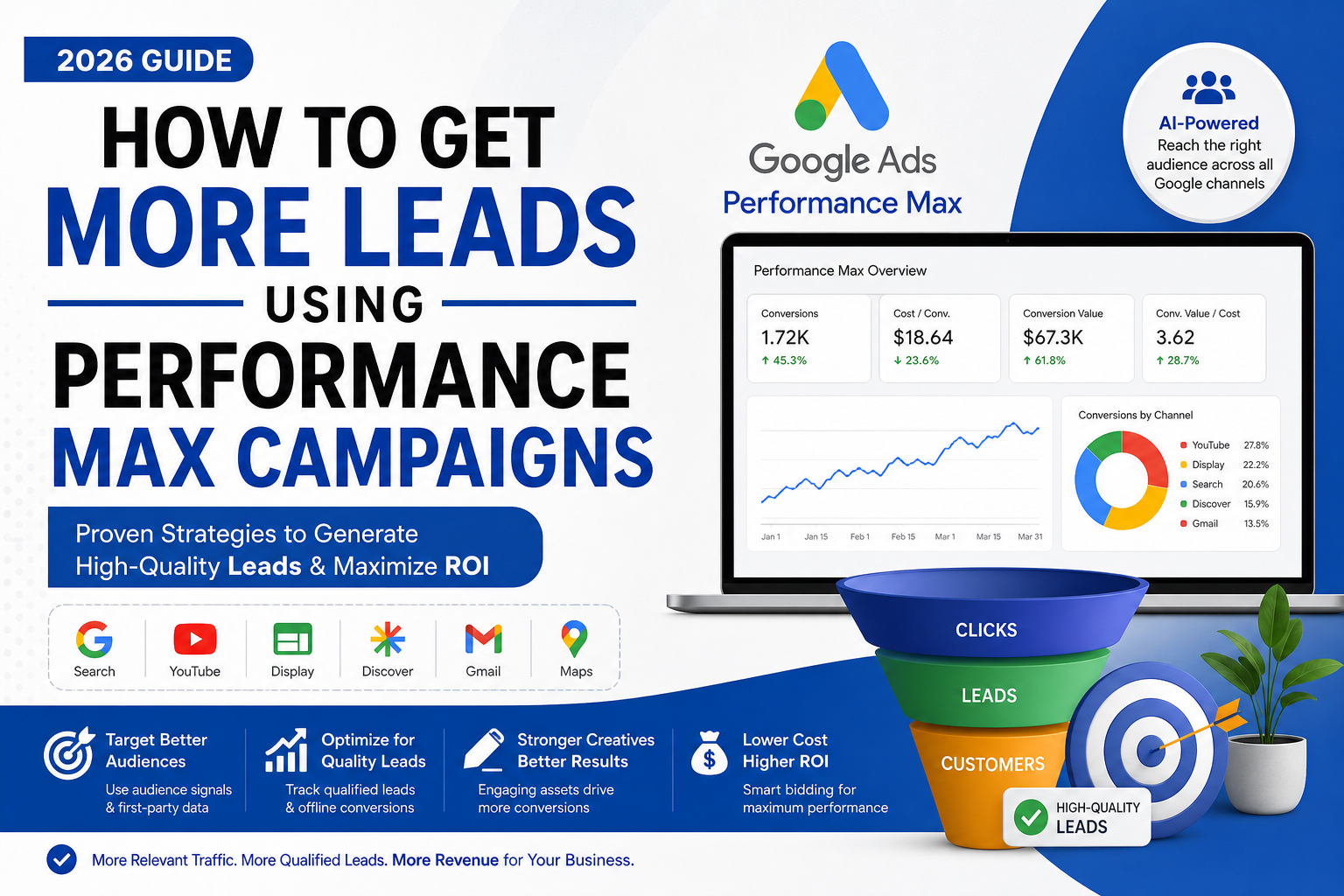
Lead generation through Google Ads has evolved significantly with the rise of Performance Max campaigns. Unlike traditional campaign types, Performance Max leverages automation, machine learning, and cross-channel delivery to reach potential customers across Search, Display, YouTube, Discover, and Gmail.
However, while many businesses have adopted Performance Max, very few are achieving consistent, high-quality lead generation. The primary reason is not the platform—it’s the strategy.
This guide explains how to use Performance Max campaigns effectively to generate more leads, improve lead quality, and scale results sustainably in 2026.
Understanding Performance Max for Lead Generation
Performance Max campaigns operate on a goal-based structure. Instead of manually controlling keywords and placements, advertisers provide inputs such as:
- Conversion goals
- Audience signals
- Creative assets
- Budget and bidding strategy
Google’s AI then optimizes delivery based on user intent, behavior, and historical data.
For lead generation, this means your success depends heavily on the quality of data and assets you provide.
Why Most Businesses Get Low-Quality Leads from Performance Max
Before improving results, it is important to understand why campaigns fail to generate quality leads.
1. Poor Conversion Tracking Setup
Many advertisers track only basic form submissions without differentiating between qualified and unqualified leads. This causes the system to optimize for volume rather than quality.
2. No Offline Conversion Data
Without CRM integration or offline conversion tracking, Google cannot identify which leads actually turn into customers. As a result, campaigns continue generating irrelevant inquiries.
3. Weak Audience Signals
Using broad or generic audience signals leads to ads being shown to low-intent users, reducing overall lead quality.
4. Poor Creative Messaging
Generic ad copy attracts everyone instead of targeting the right audience. This results in clicks from users who are not genuinely interested.
5. Unoptimized Landing Pages
Landing pages without clear messaging, trust signals, or qualification steps allow low-intent users to convert easily.
6. Wrong Bidding Strategy
Using Maximize Conversions without proper data often prioritizes cheaper leads instead of high-quality ones.
7. Lack of Campaign Structure
Running all services under one campaign confuses the algorithm and reduces targeting efficiency.
How to Avoid Low-Quality Leads in Performance Max Campaigns
Improving lead quality requires a structured and data-driven approach.
1. Track Qualified Leads, Not Just Submissions
Set up conversion tracking for high-intent actions such as calls, demo bookings, and consultations. Import offline conversions like qualified leads and closed deals.
2. Use Value-Based Bidding
Assign different values to leads based on quality and switch to Maximize Conversion Value or Target ROAS once data is sufficient.
3. Strengthen Audience Signals
Upload customer lists, use remarketing audiences, and build custom intent segments to guide the algorithm toward better prospects.
4. Improve Ad Messaging
Use clear and specific messaging. Mention pricing, target audience, or service scope to filter out irrelevant users.
5. Optimize Landing Pages for Qualification
Add qualifying questions such as budget or business type. Include testimonials, case studies, and strong CTAs.
6. Exclude Irrelevant Traffic
Use negative keywords at the account level and monitor insights to remove low-intent traffic sources.
7. Segment Campaigns Properly
Create separate campaigns for different services, locations, and audience types for better optimization.
8. Continuously Optimize Based on Data
Monitor lead-to-sale ratio, cost per qualified lead, and campaign insights. Scale what works and eliminate what doesn’t.
Core Strategies to Get More Leads Using Performance Max
1. Build a Strong Conversion Tracking Foundation
Track multiple conversion actions including calls, forms, and bookings. Integrate CRM data to track actual business outcomes.
2. Use First-Party Data and Audience Signals
Leverage past customer data, remarketing lists, and custom audiences to guide campaign learning.
3. Create High-Quality Creative Assets
Use multiple headlines, descriptions, images, and videos. Focus on strong messaging and clear value propositions.
4. Choose the Right Bidding Strategy
Start with Maximize Conversions and transition to value-based bidding as data improves.
5. Structure Campaigns for Better Control
Segment campaigns by service type, location, and audience intent to improve targeting accuracy.
6. Optimize Landing Pages for Conversions
Ensure fast loading speed, mobile optimization, strong messaging, and trust signals.
7. Allow Proper Learning Time
Give campaigns 4–6 weeks to stabilize. Avoid frequent changes during the learning phase.
8. Focus on Lead Quality Over Quantity
Analyze lead quality metrics and optimize campaigns based on actual business outcomes.
9. Use Insights for Continuous Improvement
Leverage Performance Max insights to refine targeting, creatives, and campaign structure.
Case Studies: Real Performance Max Lead Generation Results
Case Study 1: Real Estate Company (Delhi NCR)
Challenge
High cost per lead and low-quality inquiries.
Strategy
Implemented offline conversion tracking, improved creatives, and optimized landing pages.
Results
- 42% reduction in cost per qualified lead
- 65% increase in site visit bookings
- 30% improvement in lead-to-sale ratio
Case Study 2: B2B IT Services Company
Challenge
Low lead volume and irrelevant traffic.
Strategy
Segmented campaigns, used value-based bidding, and refined audience targeting.
Results
- 3X increase in qualified leads
- 50% reduction in wasted ad spend
- Higher deal conversion rates
Case Study 3: Local Service Business
Challenge
Low conversion rate with limited budget.
Strategy
Focused on geo-targeting, call conversions, and simplified landing pages.
Results
- 70% increase in inbound calls
- 35% lower cost per lead
- Improved booking rate
Common Mistakes to Avoid
- Running campaigns without proper tracking
- Ignoring lead quality metrics
- Using weak creatives
- Making frequent changes
- Not using first-party data
Final Thoughts
Performance Max campaigns are one of the most powerful tools for lead generation in 2026. However, success depends on how well you guide the system using data, creative assets, and structured strategies.
Businesses that focus on lead quality, not just volume, consistently achieve better ROI and long-term growth.