Ranking a new website on Google is difficult—not because SEO is hard, but because new websites lack trust, authority, and historical data.
Google does not know:
Who you are
Whether users will trust you
Whether your content deserves rankings
That’s why new websites must follow a different SEO strategy than established domains.
This guide explains the best SEO strategy for new websites using real-world SEO methods that help websites rank faster and more safely.
How Google Treats New Websites (Important to Understand)
Google uses a probation-like phase for new domains.
During this phase, Google evaluates:
Content relevance
User engagement
Crawl behavior
Internal structure
Link profile quality
If signals are positive, Google gradually increases visibility.
This is why aggressive SEO or shortcuts fail for new websites.
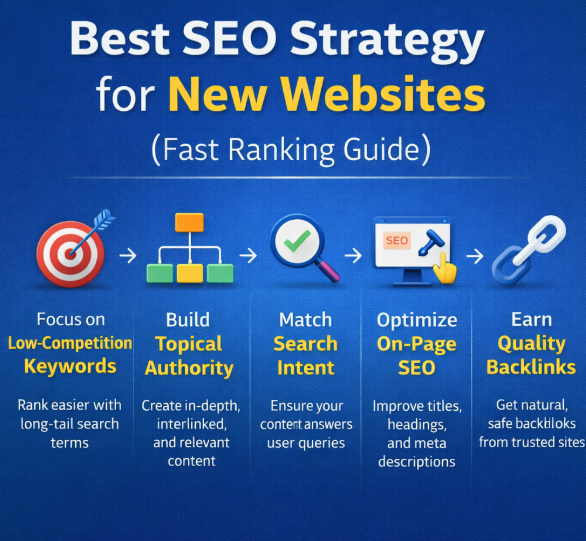
Phase 1: Keyword Strategy for New Websites (Most Critical Step)
The success of SEO for a new website depends 80% on keyword selection.
Keyword Types That Rank Faster for New Websites
New websites should target:
Long-tail keywords
Question-based keywords
Comparison keywords
Problem-solution keywords
High-Intent Keyword Examples:
best SEO strategy for new websites
how to rank a new website fast
SEO tips for new websites
new website SEO checklist
does SEO work for new websites
These keywords have:
Lower competition
Clear search intent
Higher ranking probability
Phase 2: Topical Authority SEO (How Google Builds Trust)
Google no longer ranks single articles—it ranks topic authorities.
What Is Topical Authority?
Topical authority means:
Covering a topic completely
Answering all related user questions
Interlinking content properly
Best Content Structure for New Websites
Create topic clusters, not random posts.
Main Page:
Best SEO Strategy for New Websites
Supporting Pages:
On-page SEO for new websites
Technical SEO checklist for new websites
How long does SEO take for new websites
Common SEO mistakes new websites make
Keyword research for new websites
This structure sends Google a strong signal:
“This website deserves to rank for this topic.”
Phase 3: Search Intent Optimization (Why Many Pages Fail)
Even perfect keywords fail if search intent is wrong.
Types of Search Intent:
Informational – “how SEO works”
Commercial – “best SEO tools”
Transactional – “SEO services price”
SEO Tip for New Websites:
Target informational + commercial intent first.
Google is more willing to rank new websites for:
Educational content
Problem-solving guides
Comparison posts
Avoid aggressive sales pages early.
Phase 4: On-Page SEO for New Websites (Advanced Setup)
On-page SEO tells Google what your page is about.
Advanced On-Page SEO Checklist:
Primary keyword in H1
Secondary keywords in H2/H3
Natural keyword placement
Internal links within first 150 words
Semantic keywords (LSI)
Optimized images with ALT text
Clear content hierarchy
Important Keywords:
on-page SEO for new websites
SEO optimization for beginners
website SEO structure
Avoid keyword stuffing—Google penalizes it faster on new domains.
 Phase 5: Technical SEO Foundation (Often Ignored)
Technical SEO controls crawlability and indexing.
Technical SEO Setup for Fast Indexing:
Fast page load speed (<2.5s)
Mobile-first design
HTTPS enabled
Clean URL structure
XML sitemap submitted
Robots.txt verified
No duplicate pages
Tools to Use:
Google Search Console
PageSpeed Insights
Screaming Frog (basic crawl)
Without technical SEO, rankings stall—even with good content.
Phase 6: Indexing & Crawl Budget Optimization
New websites have a limited crawl budget.
How to Optimize Crawl Budget:
Publish fewer but high-quality pages
Avoid thin content
Fix broken links
Use internal linking wisely
This helps Google:
Crawl faster
Index sooner
Rank pages quicker
Phase 7: Backlink Strategy for New Websites (Safe & Effective)
Backlinks build external trust.
Best Link Types for New Websites:
Business directories
Local citations
Guest posts (low volume, high quality)
Profile links
Contextual niche links
What to Avoid:
Paid spam links
Link farms
Automated backlinks
One natural backlink can boost rankings more than 50 spam links.
Phase 8: Internal Linking & Authority Flow
Internal links distribute ranking power.
Smart Internal Linking Strategy:
Link new posts to pillar content
Use descriptive anchor text
Avoid generic anchors like “click here”
Keywords:
internal linking SEO
website link structure
Internal linking helps Google understand page importance.
Phase 9: Content Freshness & Consistency
Google tracks:
Publishing frequency
Content updates
Engagement changes
Best Publishing Schedule:
1–2 high-quality posts per week
Update old content every 60–90 days
Consistency > volume.
Phase 10: Tracking, Improvement & Scaling
SEO is not “set and forget.”
Track:
Impressions
Click-through rate
Average position
Index coverage
Improve pages already ranking on page 2–3 for faster wins.
How Long Does SEO Take for New Websites?
Realistic timeline:
Month 1: Indexing + impressions
Month 2–3: Early rankings
Month 4–6: Stable traffic
Month 6+: Authority growth
Fast ranking means faster than competitors, not overnight.
Final Verdict: Best SEO Strategy for New Websites
The best SEO strategy for new websites is:
Intent-focused keyword research
Topical authority content
Strong on-page SEO
Clean technical foundation
Smart internal & external linking
Consistency and patience
SEO rewards clarity, structure, and value.