
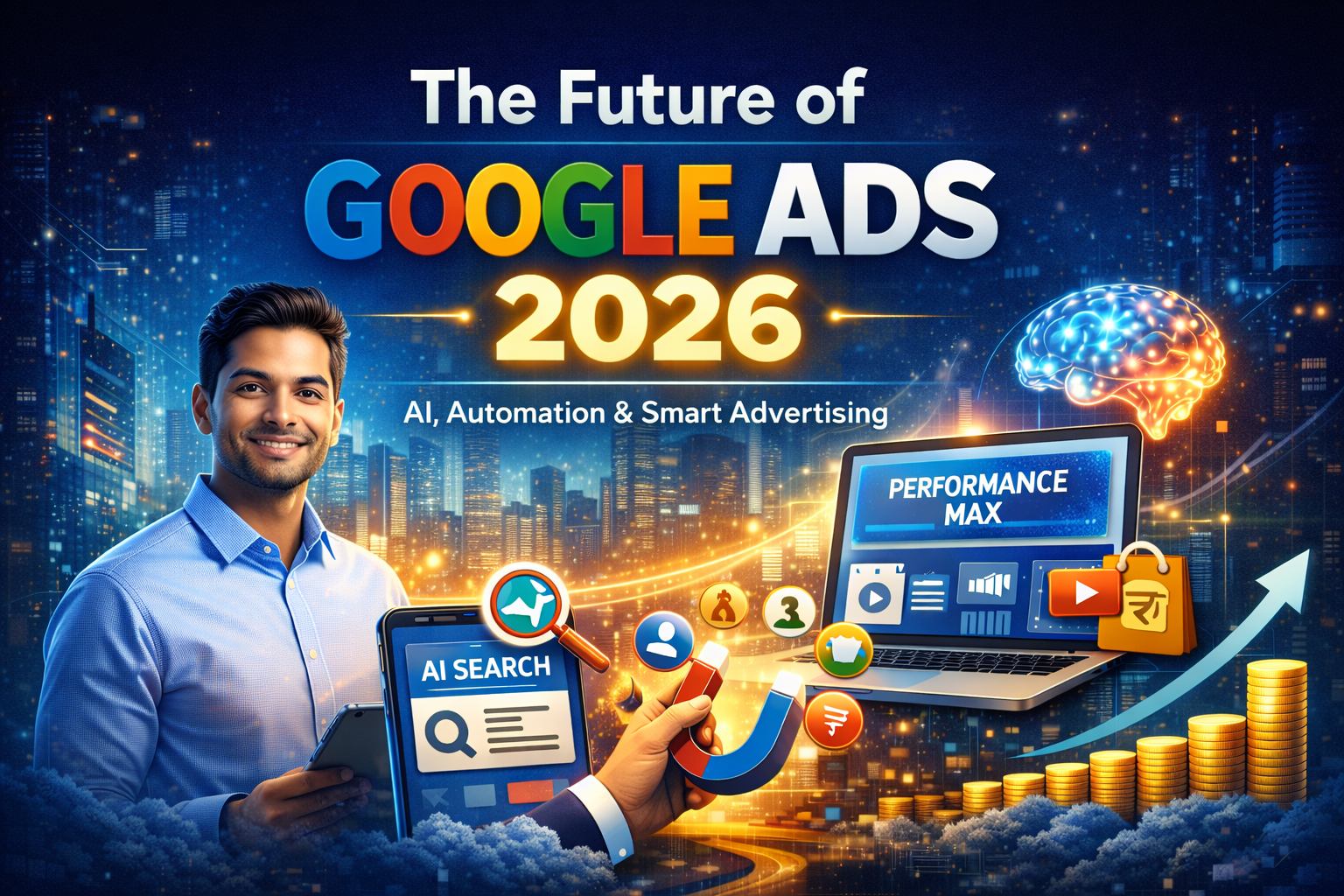
Future of Google Ads in 2026 – A Complete Guide for Businesses and Marketers
The world of digital advertising is evolving faster than ever, and Google Ads is at the center of this transformation. In 2026, Google Ads is no longer just a platform where advertisers bid on keywords and manually optimize campaigns. Instead, it has become a highly intelligent, AI-powered ecosystem that automates decision-making, predicts user behavior, and delivers highly personalized ad experiences across multiple platforms.
For businesses, especially small and medium-sized enterprises, this shift represents both an opportunity and a challenge. On one hand, automation reduces the need for manual work and technical expertise. On the other hand, it requires a completely new understanding of how advertising works. Traditional strategies like manual bidding, keyword stuffing, and isolated campaigns are quickly becoming outdated.
To stay competitive, businesses must adapt to this new environment by embracing automation, understanding audience intent, and focusing on full-funnel marketing strategies. This guide will help you understand how Google Ads is changing in 2026 and how you can leverage these changes to drive better results, generate more leads, and maximize your return on investment.
How Artificial Intelligence is Transforming Google Ads
Artificial Intelligence is no longer a feature in Google Ads—it is the foundation of the entire platform. Google’s machine learning algorithms now handle everything from bidding and targeting to ad creation and performance optimization. This means that advertisers no longer need to rely heavily on manual inputs; instead, they need to provide the right signals and data to guide the system.
AI-Driven Smart Bidding and Predictive Optimization
Smart Bidding has evolved into a highly advanced system that uses real-time data to make accurate predictions about user behavior. Instead of setting bids manually, advertisers can now rely on AI to determine the optimal bid for each auction based on factors such as device type, location, browsing history, time of day, and likelihood of conversion.
This predictive capability allows businesses to allocate their budget more efficiently, ensuring that their ads are shown to users who are most likely to take action. Over time, the system continuously learns and improves, resulting in better performance and higher conversion rates without constant manual adjustments.
AI-Powered Audience Targeting and Intent Signals
One of the most significant changes in Google Ads is the shift from keyword-based targeting to intent-based targeting. While keywords still play a role, they are no longer the primary factor in determining where ads appear. Instead, Google analyzes a wide range of signals, including user behavior, search patterns, interests, and engagement history.
This means that advertisers can reach potential customers even before they actively search for a product or service. By understanding user intent, Google Ads can deliver highly relevant ads at the right time, increasing the chances of engagement and conversion.
Automated Ad Creatives and Responsive Ads
Creating effective ad copy used to require significant time and effort. In 2026, Google Ads simplifies this process by automatically generating and testing multiple variations of headlines and descriptions. Responsive Search Ads and AI-generated creatives allow the system to identify which combinations perform best and prioritize them accordingly.
This not only saves time but also ensures that ads are continuously optimized for performance. Businesses can focus on providing high-quality inputs—such as clear messaging and strong value propositions—while the system handles the rest.
Performance Max Campaigns – The Backbone of Modern Advertising
Performance Max campaigns have become the cornerstone of Google Ads strategy in 2026. These campaigns use AI to deliver ads across all Google properties, including Search, YouTube, Display, Gmail, and Discover, from a single campaign.
What Makes Performance Max So Powerful
Performance Max campaigns eliminate the need to create separate campaigns for different platforms. Instead, advertisers provide assets such as images, videos, headlines, and audience signals, and Google’s AI takes care of distribution and optimization.
This unified approach ensures maximum reach and allows the system to identify the best-performing channels automatically. It also enables cross-channel optimization, where insights from one platform can improve performance on another.
Ideal Use Cases for Performance Max
Performance Max is particularly effective for businesses looking to generate leads, increase online sales, or promote their brand across multiple touchpoints. It is also highly beneficial for local businesses that want to reach customers within a specific geographic area while leveraging multiple advertising channels simultaneously.
The Shift Toward Keyword-Less Advertising
One of the most revolutionary changes in Google Ads is the gradual move away from traditional keyword dependency. While keywords are still relevant, they are no longer the primary driver of campaign success.
How Keyword-Less Advertising Works
In this new model, Google relies on a combination of signals, including landing page content, audience data, and user intent, to determine when and where ads should appear. This allows advertisers to reach a broader audience without being limited by specific keyword lists.
As a result, businesses can focus more on creating high-quality content and optimizing their landing pages, rather than spending excessive time on keyword research and management.
Ads in AI-Powered Search Results (AI Overviews)
Google’s introduction of AI-generated search results, often referred to as AI Overviews, has created new opportunities for advertisers. Ads can now appear within or alongside these AI-generated responses, increasing visibility and engagement.
New Ad Placements and Opportunities
These new placements allow businesses to reach users in a more conversational and informative context. Instead of simply appearing as a sponsored link, ads can be integrated into the user’s search experience, making them more relevant and less intrusive.
Optimization Strategies for AI Search
To succeed in this environment, advertisers need to focus on clarity, relevance, and value. High-quality landing pages, strong calls to action, and well-structured content are essential for capturing user attention and driving conversions.
The Importance of First-Party Data in 2026
As privacy regulations become stricter and third-party cookies are phased out, first-party data has become one of the most valuable assets for advertisers.
What is First-Party Data and Why It Matters
First-party data includes information collected directly from your audience, such as website interactions, customer emails, and purchase history. This data is more reliable and allows for more accurate targeting compared to third-party sources.
Leveraging First-Party Data for Better Results
Businesses can use first-party data to create custom audiences, run remarketing campaigns, and build lookalike audiences. This not only improves targeting accuracy but also enhances personalization, leading to higher engagement and conversion rates.
Demand Generation Campaigns and the Rise of Visual Advertising
Demand Gen campaigns represent the future of visually driven advertising. These campaigns focus on engaging users through compelling visuals and storytelling across platforms like YouTube, Shorts, and Discover.
Why Visual Content is More Important Than Ever
In a world where users are constantly bombarded with information, visual content stands out and captures attention more effectively than text-based ads. Videos, images, and interactive formats allow businesses to communicate their message quickly and memorably.
Common Mistakes Businesses Must Avoid
Despite the advancements in technology, many businesses still struggle to achieve desired results due to outdated practices and poor strategy.
Key Mistakes to Watch Out For
One of the most common mistakes is ignoring automation and trying to control every aspect of a campaign manually. Another issue is failing to implement proper conversion tracking, which makes it difficult to measure performance and optimize effectively.
Additionally, many businesses overlook the importance of landing page experience, which plays a critical role in converting visitors into customers.
Step-by-Step Google Ads Strategy for 2026
To succeed in the modern advertising landscape, businesses need a structured and data-driven approach.
Step 1 – Define Clear Objectives
Start by identifying your primary goal, whether it is lead generation, sales, or brand awareness. Clear objectives help guide your strategy and ensure that your campaigns are aligned with your business goals.
Step 2 – Use Performance Max Campaigns
Leverage the power of Performance Max to reach your audience across multiple platforms and maximize your campaign’s impact.
Step 3 – Provide High-Quality Inputs
Feed the system with high-quality assets, including engaging visuals, compelling ad copy, and accurate audience signals.
Step 4 – Monitor, Analyze, and Scale
Continuously track your campaign performance, analyze the data, and make informed decisions to scale your results over time.
Future Trends in Google Ads You Cannot Ignore
Looking ahead, several trends are expected to shape the future of Google Ads, including AI-generated creatives, voice search advertising, visual search integration, and hyper-personalization. Businesses that stay ahead of these trends will have a significant competitive advantage.
Final Thoughts
The future of Google Ads is undeniably driven by artificial intelligence, automation, and data. Businesses that adapt to these changes and embrace new technologies will be better positioned to succeed in an increasingly competitive digital landscape.
Rather than resisting change, marketers should focus on learning how to work with AI, leveraging its capabilities to enhance their strategies and achieve better results. By doing so, they can unlock new opportunities for growth and stay ahead of the competition.